Innovative material analysis at INNOVENT e.V.

January 27, 2026

Innovative material analysis with the EasyTom CT system at INNOVENT e.V.

A field report from applied research
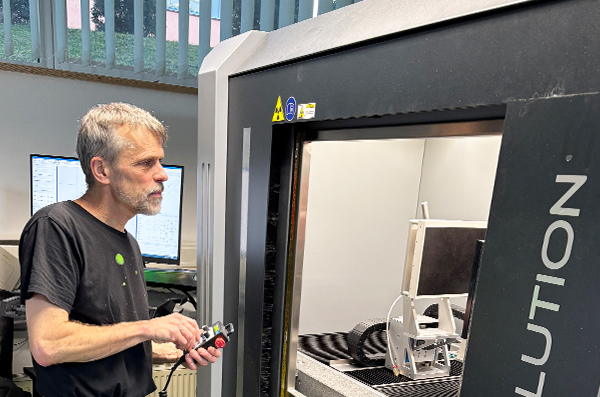
“The EasyTom CT system has expanded our material analysis into the third dimension. We can now not only scan samples externally, but also look inside them with ‘X-ray eyes’.”
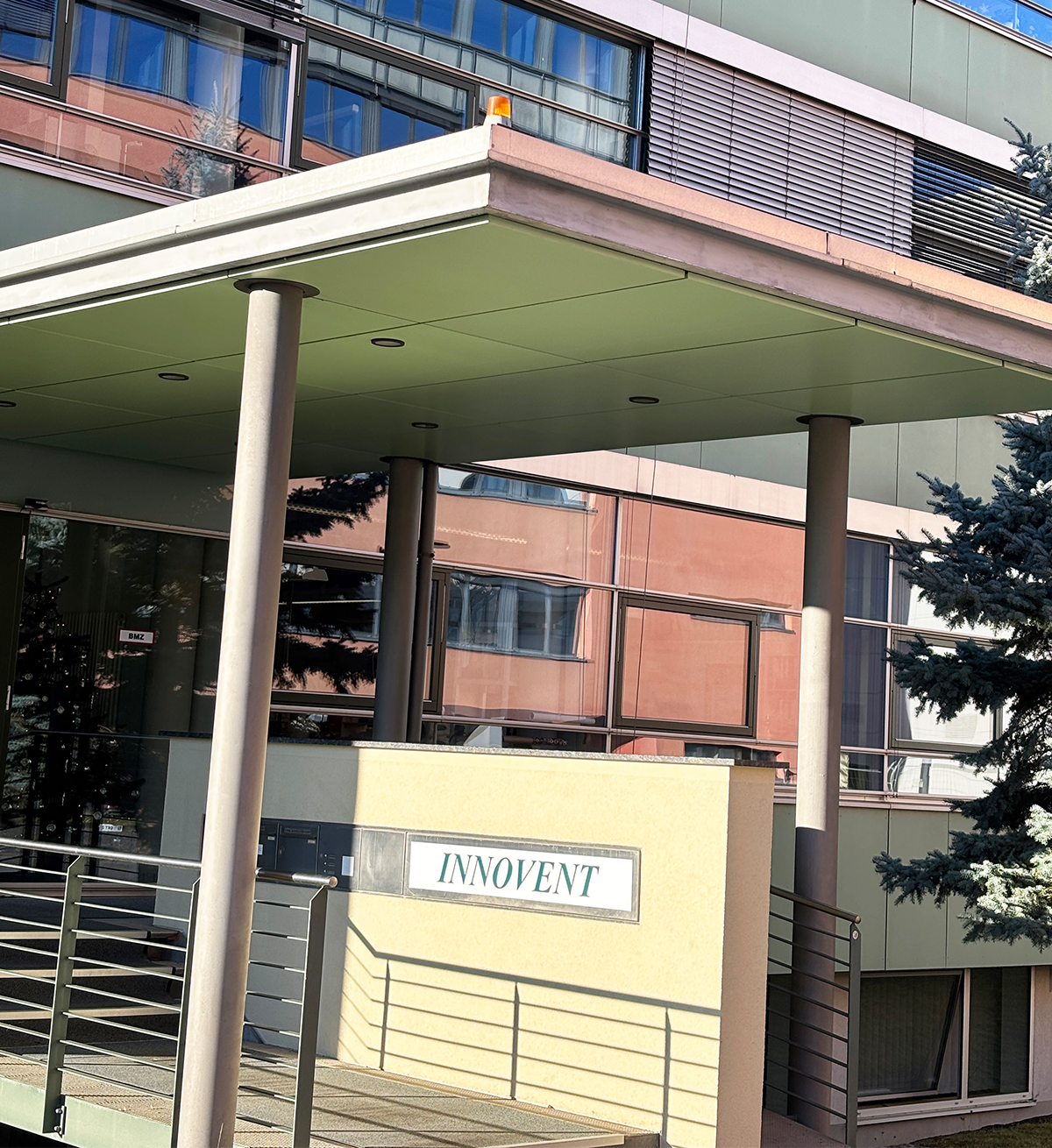
Dr Frank Froehlich and Dr Ralf Linke, INNOVENT e. V. Technologieentwicklung Jena

Who is INNOVENT e.V.?

INNOVENT e. V.Technologieentwicklung Jena is a medium-sized research and development institution in Germany. The institute is a member of the Zuse-Gemeinschaft and supports industrial partners with innovative solutions, particularly in the field of material analysis and material development. For three years, the CT team at INNOVENT has been successfully using the state-of-the-art EasyTom computer tomography system from RX Solutions, which was purchased through Physical Electronics GmbH.

Requirements and solution

For precise material analysis, INNOVENT requires powerful, high-resolution computed tomography that examines complex components with as little destruction as possible.

Due to the institute’s research focus, a device was needed that could perform both high-resolution CT scans on microscopic samples and CT scans on macroscopic multi-material samples.

INNOVENT found what it was looking for in the French manufacturer RX Solutions, whose devices are distributed in Germany by Physical Electronics GmbH.

RX Solutions manufactures a series of devices whose sample spectrum ranges from “small and soft” to “large and hard,” whereby hardness here refers to the energy of the X-rays required for analysis.

Sample size and resolution are opposing parameters in computed tomography, between which a compromise must be found.

For INNOVENT, this compromise has been achieved by the “EasyTom”, which can scan both millimetre-sized samples and samples up to a maximum height of 70 cm and a diameter of 32 cm.

This enables an “X-ray view” of both bacterial cultures and tree trunks.

Application and benefits

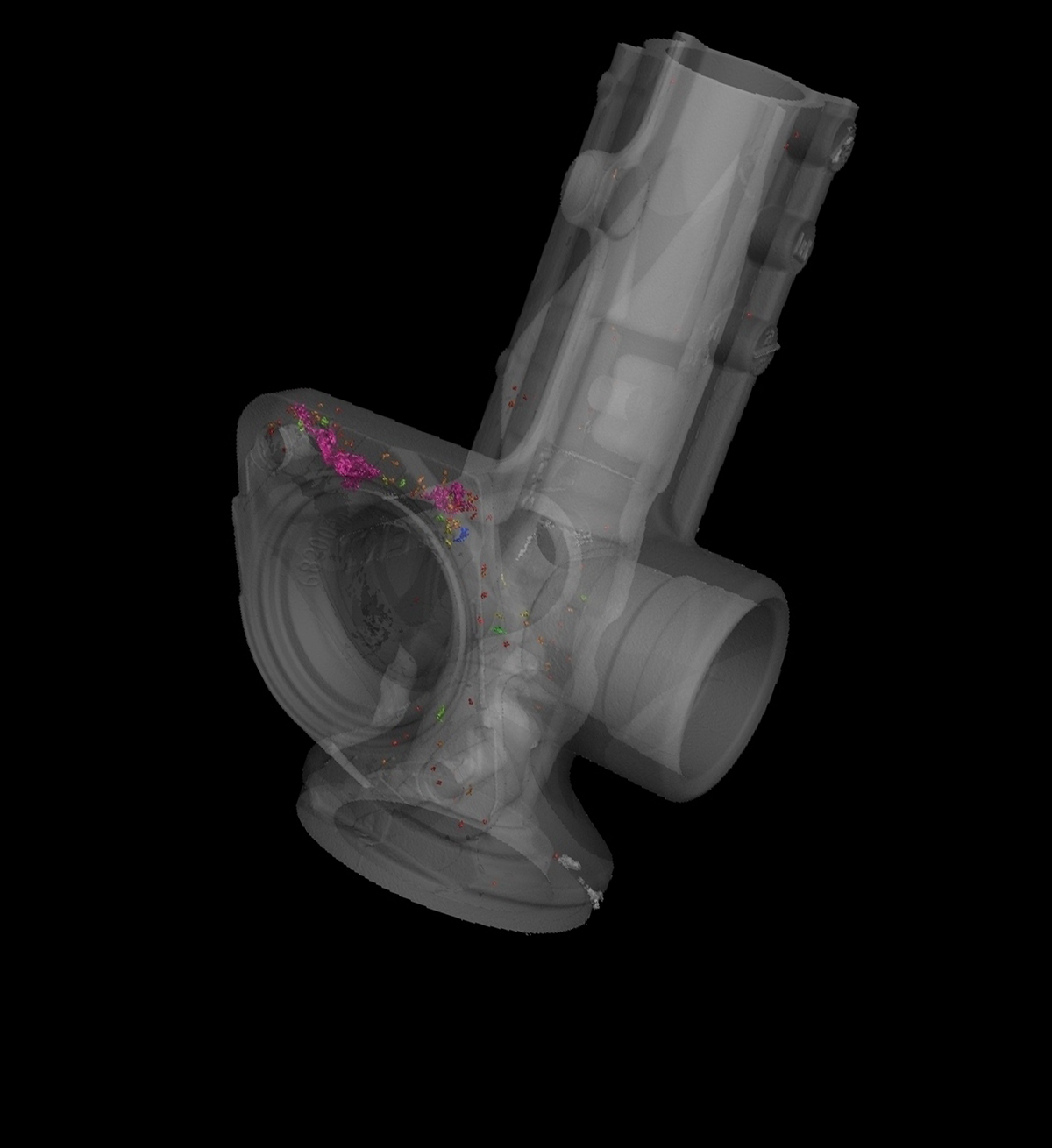
INNOVENT uses EasyTom to perform a wide range of analyses, including the measurement of internal structures (e.g. in magnetic field sensors), the detection of faults (e.g. on printed circuit boards) and material defects (e.g. in glass), as well as the quantification of porosity (e.g. in porous plastics).

Extracting the desired results from the huge 3D point clouds requires powerful software that is constantly being developed and adapted to the growing range of tasks.

This benefits above all the institute’s research projects with its cooperation partners, as computer tomography can be seamlessly integrated into the projects.

Customer satisfaction and cooperation

Dr Froehlich emphasises the excellent service and competent support provided by Physical Electronics GmbH. Maintenance, technical support and upgrades are carried out reliably and quickly, ensuring smooth operation on a daily basis.

Conclusion

The investment in the EasyTom CT system has significantly improved material analysis at Innovent e.V. and forms an important basis for innovative research projects. Dr Froehlich recommends the system and the cooperation with Physical Electronics GmbH as a reliable partner.

Interview with Dr Froehlich (INNOVENT e.V.)

Unabridged version

The device had to be capable of performing CT scans of relatively large samples with a relatively high resolution.
This meant striking a balance between two opposing parameters.
On the one hand, it should be possible to measure “soft” biological samples with a voxel size in the micrometre range; on the other hand, it should be possible to scan relatively large samples from industrial customers with relatively high “X-ray hardness”.
Neither tabletop CT devices specialised in serial scans of rats nor industrial tomographs designed for X-raying entire engine blocks can do this.
We were therefore looking for a compromise device that was also affordable for a medium-sized research institute.

In-house, computer tomography is increasingly being used in research and development projects with external partners as an analytical tool for specific tasks, thereby enhancing their value.
Word has spread about the expertise we have gained in the meantime, leading to enquiries and independent CT measurements for external customers.

CT competes with optical scanning methods. There are many of these, and INNOVENT is also well-positioned in this area.
Optical scanning methods are usually faster, cheaper and often more accurate than computer tomography.
However, as purely “surface methods”, they cannot see inside samples. If this is necessary, there is no way around computer tomography as a “volume method” that can also “scan” the inside of samples with an X-ray beam.
Optical scanning methods and computer tomography are, therefore, complementary analytical methods. CT can also be seen as an extension of materials testing into the third dimension.
And, incidentally, computer tomography also provides the results that surface methods can deliver.
This means that a single method can be used to examine both the external shape of complex samples and their internal structure.
There is a lot to explore within materials: pores, cracks, textures, inclusions, grains, and crystallites are hidden defects that cannot be scanned with laser beams. Even intentional cavities, such as those in injection-moulded plastic parts, can be measured with CT.
And if a circuit board is to be launched into space, you want to know for sure that the solder joints are OK.

We have now developed a good working relationship with the archaeologists at Friedrich Schiller University. As part of the “Das Collegium Jenense” project, we have, we analysed archaeological finds from the “Collection of Prehistory and Early History” (UFG) using CT.
Our particularly high sample chamber enabled us, for example, to detect an inscription inlaid in copper (tarnishing) under the corrosion layer on a sword found in the ruins of the former university church. This find contributes to the history of the university and demonstrates the importance of the first Protestant university in the European context.
The results of the CT scan spare archaeologist Dr Enrico Paust and restorer Ivonne Przemuß the task of uncovering the inscription.

It is a widespread myth that measuring devices are becoming increasingly complex, while operators with less and less time and expertise are delivering ever better measurement results with just a few mouse clicks.
CT measurements can sometimes take many hours for complex multi-material samples and high resolutions (regardless of the manufacturer of the CT device) and, as with many measurement methods, the evaluation of a complex measurement can also take longer than the actual measurement.
I have yet to meet anyone who has worked on several computer tomographs from different companies and can compare them. The French manufacturer RX Solutions alone offers a whole portfolio of CT devices, ranging from relatively small devices to large industrial scanners.
So I can only describe the “EasyTom” in our institute.
The most important components in the sample chamber – beam sources, sample holder and detector – allow for very flexible alignment of the sample in the cone beam in the EasyTom. This flexibility is a basic requirement when the sample spectrum ranges from small entomological samples to large archaeological samples. These are special samples, each of which is installed and measured differently. And unlike the larger CT devices from RX Solutions, our device still has lead glass windows, so we can visually check the alignment of the sometimes very bulky or very sensitive samples in the sample chamber and thus also avoid damage from collisions.
On the other hand, it is also possible to measure a sample series with the same geometry using macros with the same measurement configuration and to partially automate the evaluation depending on the measurement task.
In principle, measurements on sample series can be automated even further. We do not have the necessary sample changers for this. This only makes sense if there is a high volume of similar samples in combination with automated evaluation and appropriate management of the large amounts of data generated.
Maintenance, inspection and validation of the device are also important. RX Solutions offers tools that allow the device to be checked and adjusted.

Contrary to what is now unfortunately a widespread belief, modern measuring devices are not maintenance-free, and technical problems will naturally arise sooner or later with such complex devices. They are not coffee machines, after all.
Anyone who wants to purchase a CT device must also consider software upgrades. This is specialised software, the licences for which usually have to be renewed annually and for which there is usually no alternative. This cost factor is often underestimated, but must be taken into account.
You can save on maintenance, support and upgrades, but then you end up spending the money elsewhere – for example, on inefficient evaluations with outdated software or downtime of an expensive measuring device.
We have had excellent experiences working with Physical Electronics GmbH. There has been no problem that Physical Electronics GmbH has not been able to solve, and the cooperation works on an equal footing.
This is a company with more than twenty years of experience in the distribution of highly complex measurement technology.

In measurement technology, accuracy is only a qualitative term that is often confused with the resolution of a measurement method, in computer tomography, the spatial resolution.
Quantitative parameters for evaluating a measurement method are accuracy and reproducibility (repeatability – how many decimal places can be reproduced; also referred to as precision), which must be traceable to a standard in the case of high analytical requirements (traceability).
RX Solutions naturally offers standards for checking these parameters.
The focus of a CT measurement depends on the task at hand. The spatial resolution, often indirectly expressed as voxel size, is primarily determined by the position of the sample in the cone beam between the beam source and the detector and is not automatically a quality feature.
High spatial resolutions are only possible with small samples that can rotate in the cone beam close to the beam source. This geometric law applies regardless of the manufacturer of a CT device if the imaging is based on the cone beam principle.
As with all measurement methods, the measurement effort and costs increase when the technical limits are reached. When planning to purchase a CT device, it is therefore necessary to consider how often CT measurements with high spatial resolution will be required.
Anyone responsible for quality assurance on engine blocks coming off the production line must pay attention to accuracy, precision and traceability. High spatial resolution is not possible at all on such large samples.
In contrast, high spatial resolution is necessary for analysing structures in a tiny circuit.
For an archaeologist who wants to know what is inside misshapen lumps, all these quality parameters are less important. What is important to them is that the sample can be X-rayed.
Statistically speaking, samples from electrical engineering have been the most common samples to date. High spatial resolutions are rarely important or possible for these samples. To do this, the energy of the beam source must be sufficient to separate the various metals and metal compounds from silicon and polymer in these multi-material samples.
With the EasyTom, which our institute has chosen, we have successfully measured tiny samples with a voxel size of up to 1 µm. Formally, more is possible, but this has not yet been necessary.
However, we were also able to place a corroded sword from an archaeological excavation in the sample chamber.
Not many CT devices on the market can handle this range, from samples measuring a few micrometres to samples up to 70 cm long. This flexibility was important to us, and the EasyTom makes this compromise possible.

I see the following points here:

  • CT systems have become indispensable in many industries and are essential for quality assurance, but also for research and development. A manufacturer of printed circuit boards needs this measurement method in-house. For manufacturers of space technology, the absolute reliability of soldered joints, for example, is a must. Computer tomography has also become indispensable in diagnostics in the medical industry.
  • As a computationally intensive method, computer tomography is currently benefiting from developments in computing technology in the field of graphics processing. Every year, software updates are released that accelerate or improve evaluation, but also cost a lot of money. Software manufacturers respond to new areas of focus in research and development with corresponding add-ons, e.g. for CT examination of batteries.
  • As an alternative to the widely used large devices, smaller CT devices have appeared on the market that fit on a stable laboratory table, can be operated by a laboratory assistant, include free software updates and require less administrative effort for radiation protection approval. This promotes the further spread of the method.
  • Specialists are pushing the boundaries of computer tomography. The Fraunhofer Development Centre for X-ray Technology in Fürth (EZRT) is able to X-ray samples such as aircraft fuselages and cars. The University of Hamburg, on the other hand, has teamed up with DESY to develop a mobile scanner that can now be used to scan museum collections, especially cuneiform tablets. Here, the CT device is being transported to the site for testing.

As with other complex measurement methods, an institution must carefully consider whether to purchase its own CT device or to outsource CT measurements to an external partner or service provider.
If you want to acquire this method yourself, you also have to plan for the necessary manpower and expertise. Otherwise, you will have invested a lot of money in technology that is not being used. Licence renewals and software updates also generate high costs.
The costs generated by a CT system must also be recouped. And with over 200 CT service providers in Germany, you are not alone in the market.
If a company is not prepared to invest in manpower and ongoing software costs, it should not purchase a computer tomograph.

The following arguments speak in favour of purchasing your own CT scanner:

  • Quality assurance in a manufacturing company in the high-tech industry. Here, production downtimes incur high costs (e.g. printed circuit board manufacturers).
  • The CT method is established in a field of research and is a prerequisite for further projects (e.g. “rat scanners” in medical research).
  • In an institute (such as INNOVENT), tasks with very different requirements for CT measurements are carried out. Here, it is better to build up (and retain) expertise in-house than to constantly search for suitable CT specialists.

The following arguments speak against purchasing your own CT device:

  • Problems that require CT to solve are rare. In this case, it is definitely better to call on the expertise of an experienced service provider.
  • You already cooperate with partners who have CT in their portfolio.
  • You often have problems that require CT to solve, but you cannot or do not want to afford the investment. For this situation, there are service providers who also measure large sample series on commission.

If you want to purchase your own device, you will naturally compare several suppliers. When you purchase a CT device, you are committing yourself to a manufacturer in the long term.
RX Solutions offers a broad portfolio with something for almost everyone, very robust hardware and a reliable basis for sales and support in the UK through Physical Electronics Ltd.
RX Solutions is not standing still, but is constantly developing its devices. For example, the EasyTom L is already a more powerful successor to our device.
If you prefer to outsource CT measurements as a service, I think it’s a good idea to outsource them to Physical Electronics GmbH or perhaps even INNOVENT.
Of course, there are now other CT service providers in every major industrial region.

Since we had to measure more metal-containing samples than expected, we would like to have a beam source with more energy.
In future software versions, the evaluation of multi-material samples with many artefacts should be a standard feature. After all, the wheels are included in the price of a car.
Often, there is also a combination of “on-board software” from the device manufacturer and an add-on package of exclusive software from a third-party provider. This generates considerable software costs. It would be nice to halve the software costs with a software package from a single source. However, this is not to be expected at present.
A dream come true for “tomographers” is a tunable monochromatic X-ray laser that fits into a CT device, but this is not currently in sight. Such a device would revolutionise the method of computed tomography once again.

EasyTom L – Overview

– Blog –

Learn more about this product…

Go to Top